Your first chore: brief it like a new colleague
Pick a boring task, write it the way you would explain it to a new hire, and keep control while your Aivell learns it. A first chore, step by step.

Tuesday, 9:10. Sara starts today. You walk her to her desk, coffee in hand, and explain the holiday requests in four minutes. They come in by email. They go in the shared sheet. No more than two people from the warehouse off in the same week. Anything longer than two weeks comes to you first.
She nods, writes three lines on a sticky note, and by Thursday she handles them without asking. Those four minutes are the whole secret of automating a task, and you have already done them a hundred times. Here is how to do them once more, for your Aivell, and what happens after.
What is a chore, exactly?
A chore is a task you hand to your Aivell, written the way you would explain it to a new colleague. Plain sentences, your own words, in English, Spanish, French or Italian. No diagram to draw, no code, no form with forty fields.
Every chore has three parts.
- A start. An email arrives, someone fills in a form on your site, or the clock reaches the time you chose.
- Steps. What to read, what to check, what to write, where to file it.
- Your rules. The ones that live in your head today: a threshold, an exception, the name of the person who decides.
The third part is what makes the chore yours. “If the dates clash with the stocktake, don’t guess - ask Marco” is a perfectly good instruction. It is exactly the kind of sentence your Aivell is built to follow, because offices run on sentences like that.
The chore lives on the box in your office, next to the documents it works on. Your rules about who approves what, and which customer gets a phone call instead of an email, stay there with it.
Which task should come first?
Not the most important one. The most boring one.
A good first chore has four traits:
- It comes back often. Every day or every week, not twice a year.
- You can explain it in two minutes. If the briefing needs a whiteboard, keep it for later.
- The rules already exist, even if nobody wrote them down. “We always do it this way” counts.
- A mistake is cheap to fix. A request filed in the wrong row, not a letter to the wrong customer.
Holiday requests, chasing a supplier for a delivery date, filing incoming documents in the right folder, a Monday report from the order sheet: these make good first chores. They are also the kind of work behind the 62% of employee time spent on repetitive tasks, a few minutes at a time, every day.
Pick one. You do not need a plan for the whole office on day one: the Start tier holds three chores, enough to see what your Aivell does in your office before you hand it more.
What goes into the briefing?
Four things, in the order you would say them to Sara.
- When it starts. “When someone writes to holidays@” or “every Monday at 8”.
- What to do. The steps, in order, as short sentences.
- Your rules. The threshold, the exception, the colleague who decides. One or two real ones beat ten vague ones.
- When to ask. The moment you want a person to look before it goes on.
Here is the briefing from the opening, written down:
Holiday requests
When someone writes to holidays@ asking for time off, read the dates and check them against the holiday sheet.
If the request fits, add it to the sheet as “pending” and reply to the colleague that it has arrived and will be confirmed by Friday.
No more than two people from the warehouse can be off in the same week. If a request would make it three, don’t refuse it: tell Marco which weeks clash and wait for his answer.
Requests for August must arrive by 31 May. Later ones go to Anna with a short note.
Anything longer than ten working days goes to Anna before you reply.
Every Friday at noon, send Anna the list of pending requests so she can confirm them in one go.
Ten sentences. Nothing in there you could not say out loud at the coffee machine. That is the point: if you can say it, you can write it, and if you can write it, your Aivell can follow it.
Notice what is missing. There is no list of every possible case. You did not explain to Sara what to do with a request written in capital letters, or one that arrives on a Sunday. You trusted her to ask. The chore works the same way.
What happens after you write it?
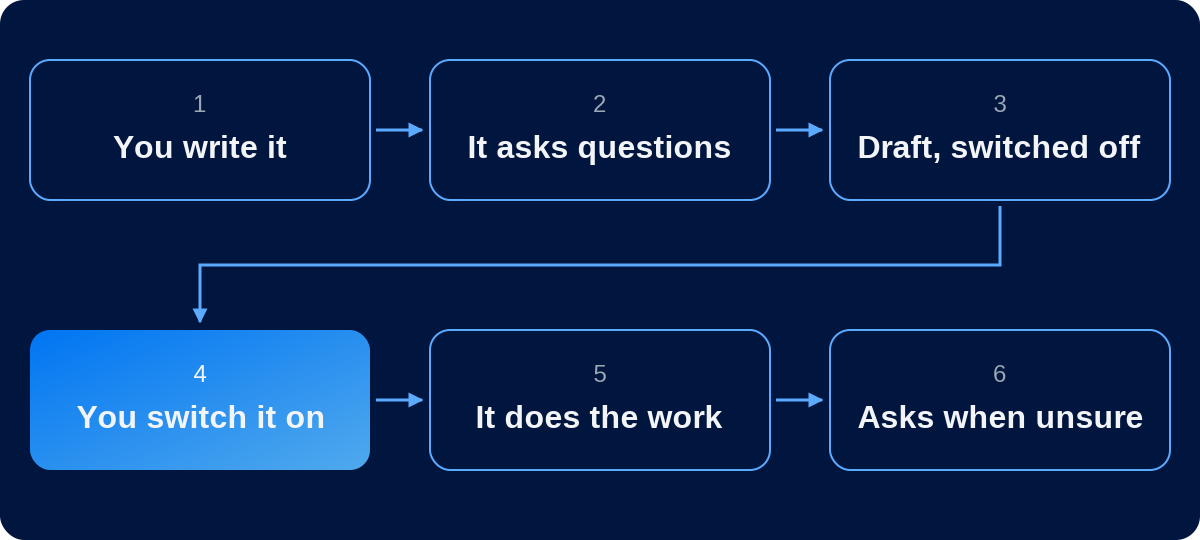
Your Aivell does not start working the moment you finish typing. It reads the chore with you first, the way a careful new colleague would on day one.
It asks about the cases you did not cover. What if someone asks for half a day? What if the dates are written as “the week after Easter”? Who decides when Marco is away? You answer each in a line, and the answers go into the chore.
It confirms the tools it will use. Here: Email to read requests and reply, Spreadsheets for the holiday sheet, Calendar if you want confirmed days to show up there. And it proposes guardrails, hard limits on each tool. For this chore, sensible ones are: it can add rows to the holiday sheet but not change existing ones, and it replies only to addresses inside the company. Guardrails are not advice it may ignore. An action they block does not happen.
If you would rather not write at all, describe the task in the chat. Your Aivell asks until the goal is clear and drafts the chore for you, in the same plain language, short enough to check in a minute.
Either way, the draft stays switched off. A new chore does not run until a person switches it on, and your Aivell cannot switch on a chore it wrote itself. Talking about replying to colleagues never replies to a colleague.
How do you keep control in the first week?
The same way you would with Sara. You watch more at the start, and less once the work has earned it.
For each chore, and for each tool inside it, you choose how closely you follow:
- Notify on everything. It acts, and every action shows up in your feed.
- Notify on specific tools. Routine steps run quietly; the ones you care about ping you as they happen.
- Approve each request. The step is prepared and held until someone says yes, with a tap on the phone.
Most people start strict. In week one, every reply to a colleague waits for your tap. You read the first ten, they are fine, and you loosen it. The pause before Marco’s decision stays, because that one is a judgment call, not a routine.
Every action lands in the audit trail on the box: what came in, what it did, who approved it and when. “Why is Luca’s week still pending?” always has an answer, and you do not have to remember it.
Be realistic about one thing. Guardrails stop what is not allowed; they do not make the work perfect. Like any new colleague, your Aivell can misread a date or miss a step. That is why the first week is the strict one, and why the chore is written in words you can check against what happened.
If something looks wrong, there is a stop. One chore, a folder of chores or the whole box, in one click. Stopped work waits exactly where it was until you reactivate it.
How do you change it six months from now?
You read it. Then you change a sentence.
This is the part people underrate. A chore stays in plain language, so the person who knows the job can still read it in a year. When the warehouse grows and three people off is fine, “two” becomes “three”. When Anna hands the holidays to Marco, you change a name. When you want to see every Friday list yourself, you add a line: “Copy me on the Friday list.”
Nobody has to remember how it was built, because nothing was built. There is a text, you wrote it, and you can read it.
The same goes for the second chore, and the third. Each one is a briefing you already give. Writing it down is the only new step.
Where to start
- Write the two-minute version. Take the task you picked and write it as if Sara started tomorrow: when it starts, the steps, two real rules, when to ask. Do not polish it. Short and honest beats complete.
- Answer the questions. Let your Aivell ask about the gaps, answer each in a line, read the guardrails it proposes, then switch the chore on with approval on every step that writes to someone.
- Read the first week. On Friday, go through the audit trail. Loosen what was fine, tighten the sentence that was not.
You do not have to do the first one alone. Your partner helps you get started and writes the first chores with you; that is part of what they do.
Sara needed a sticky note and two days. Your Aivell needs the same briefing, written down once, and it stays written. More on why plain sentences beat flowcharts on the plain-language automation page.
Meet your Aivell before everyone else.