Chores you can read mean fewer support calls
Why an Aivell keeps every chore in plain language, and what that does to your support load: no per-client flow to rebuild each time an office changes its mind.
Become a partner
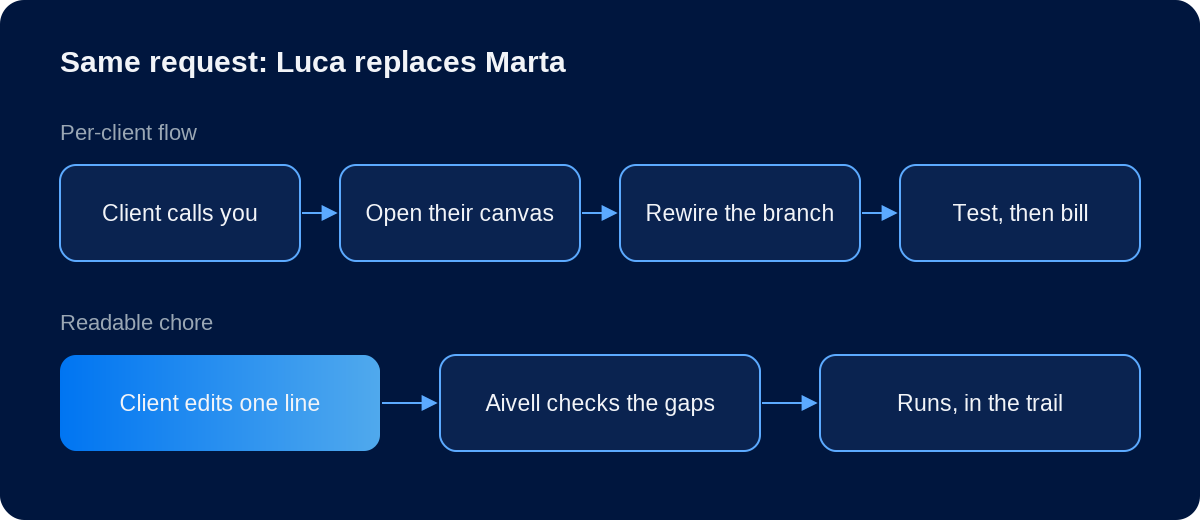
Tuesday, 9:15. A client calls. Marta is going on leave in March, and from now on Luca should get the reminders. In most automation setups that is a ticket: you open the flow you built for them last spring, find the branch with Marta in it, change it, test it, and bill a quarter of an hour nobody is happy to pay.
With an Aivell, the client opens the chore, reads “tell Marta”, writes “tell Luca”. The call does not happen. This post is about why that matters more to you than to them.
What does the client actually own?
The chore. A chore is the procedure an Aivell follows, written in plain language (English, Spanish, French or Italian today) the way an office manager briefs a new colleague: numbered steps, the client’s own words, thresholds, exceptions, colleagues’ names.
It does not compile into something else. There is no canvas behind it, no diagram, no code the client cannot open. Six months later, the text that runs is still the text the client wrote with you. That is the design decision: the procedure stays the source, readable by the person who knows the job, not only by the person who installed the box.
For you, that settles who owns what. You own the installation, the integrations, the first chores and the relationship. The client owns the content of their procedures. Those are the right owners. They know when Marta leaves. You know how the mail server is set up.
The flow you build is the flow you maintain
The usual alternative for a non-technical office is an integrator-built flow. Any tech-savvy client will bring up n8n: a visual canvas with code nodes, powerful, and in a small firm it means someone like you builds it and keeps it running. Several of the on-premises AI boxes now pitched to MSPs follow the same pattern: Zylon ships n8n inside, and Yeren’s agents assume the MSP builds them.
The cost is not the build. It is what comes after.
- Every exception is a branch. “Unless the client is marked phone only” doubles a path. “Not in August” adds another.
- Every branch is yours. The client cannot read the canvas, so every change goes through you, however small.
- It multiplies. Ten clients, ten canvases, each a small map that one person can read. If that person is you, your calendar is full of other people’s Tuesdays.
A retainer looks like recurring revenue. It is recurring work, and the hours grow with the client count.
What a readable chore looks like
Here is a chore for an accounting office, the kind you would set up in the first week:
Chase missing documents for the tax returns
Every Monday at 8:00, open the sheet “Tax returns 2027” and look at the clients with documents still missing.
- Write to each one, politely, listing exactly what is missing. Use the client’s language; Italian by default.
- Do not write to anyone marked “phone only”. List them for Marta instead.
- After the third reminder with no answer, stop writing and tell Marta, with the history.
- When a document arrives, tick it in the sheet. Ask Marta before marking a client complete.
Send Marta a summary of the week by 10:00.
Every rule in it is one a flow would turn into a branch. Here each is a sentence. When the office decides that reminders stop after two attempts instead of three, someone in the office changes one character. When Luca replaces Marta, they change a name.
What makes a written line safe to edit
Letting the client edit is only a relief if an edit cannot break things. Plain language in does not mean loose behaviour out.
When a chore is written or changed, the Aivell works through it first. It asks about the case nobody covered (“what if a client answers with the wrong document?”), confirms which tools it will use, and proposes guardrails: limits enforced on the tool itself, not polite suggestions in a text. The spreadsheet tool may update the status column, and editing anything else is blocked. A blocked action fails at the tool, whatever the chore says.
On top of that:
- Approvals from the phone. Steps the client marks as sensitive pause and wait for a person, like Marta marking a client complete.
- An audit trail. Every action a chore takes is recorded. When a client asks why a reminder went out, the answer sits next to the line that caused it.
The honest limit: guardrails block what is not allowed, but the AI can still fail a step or get it wrong. That is why the trail and the approvals exist. And the support call that remains is the useful kind: “it did this, the chore says that”. You read the same text the client reads, and you both see the gap.
Where your hours go instead
Your time moves to work that is worth paying for. Installation. Integrations: the mailbox, the network folders, the database. The first chores, written with the client in the room. New chores when another department wants in.
Growth does not turn into a rebuild either. Moving a client from one tier to the next, or between the cloud and the box, does not mean rewriting a single chore: the procedures stay the same. When an office outgrows the three chores of the Start tier, the three it already has keep running untouched on Pro.
Where to start
- Pick one procedure the client already explains the same way every time. Document chasing, a shared inbox, appointment reminders. Something that already lives in someone’s head as a list.
- Write the first chore with the person who does the job today, in their words, not yours. Let the Aivell ask its questions in front of them; the answers are the exceptions you would otherwise discover in a ticket.
- Before you leave, have them change one line themselves. A name, a time, a threshold. That ten-minute exercise is the training, and it is the call you will not get in March.
The fewer things only you can read, the more clients you can look after. There is more on how chores are written, and why there is no flowchart behind them, on plain-language automation.
Bring an AI colleague to the businesses you already serve.
Become a partner