No meter: the quote you sign is the invoice they get
A fixed monthly fee with no per-use billing changes how an AI colleague is quoted, renewed and grown, for the business that pays it and the partner who sells it.
Become a partner
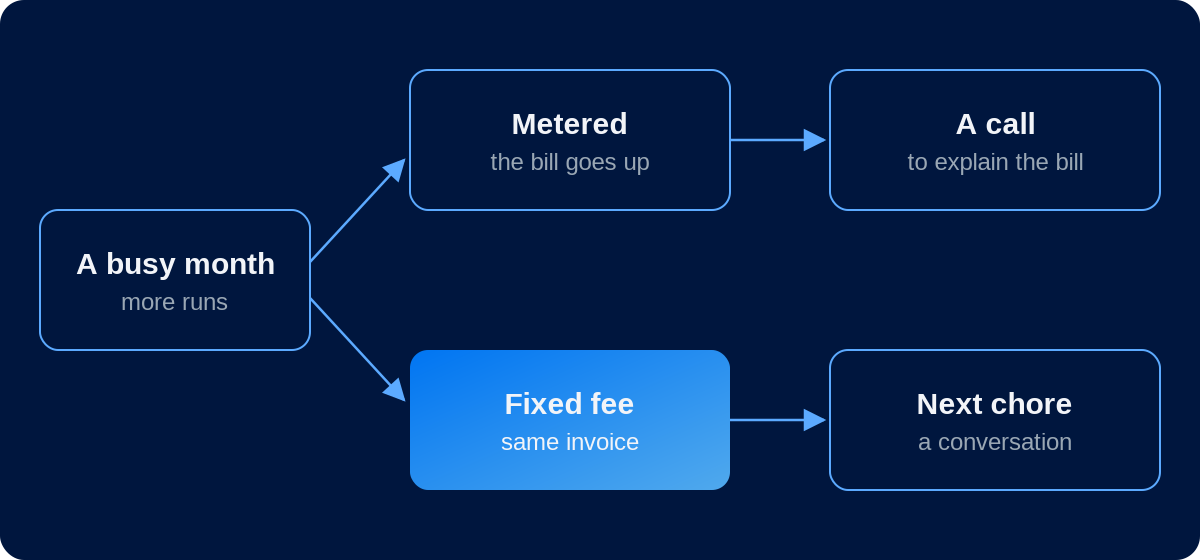
March. A business that started with AI in January forwards its invoice to the partner who set it up, with one line: “Is this right?” It is right. They used it more. That is what a metered service does, and somebody has to explain it.
Most AI tools bill by use: per message, per credit, per run, units of work the vendor counts and charges for. The bill grows exactly when the tool gets useful. The quote turns into an estimate nobody can stand behind, not the business that signs it and not the partner who wrote it.
What goes on the quote?
An Aivell has two lines: a one-time setup fee and a monthly fee for the tier. There is no per-use rate, and nothing on the invoice moves with use.
For a box in the office, the setup fee covers the hardware, its preparation and shipping. In the cloud there is no box to set up. Either way, the monthly fee is the same every month, so the total for the year can be written in the proposal in January and still be true in December.
The tier sets how much work fits. Two measures: chores, the distinct jobs handed over (“sort the leave requests”, “register the supplier invoices”), and runs, how many times a month a chore is carried out, one per email, form or request handled. A higher tier does not make the Aivell smarter. It gives it more room to work.
A fee nobody has to ration
On a meter, every use has a price. So people start asking whether a chore is worth running on every email, and some switch it off in a busy week, which is exactly when it was needed. On a fixed fee that question goes away. The chore runs on every email, and the box earns its place in the office.
The same holds for the books. The line on the invoice is the same every month, so the budget for AI is a number, not a range with a caveat. The bookkeeper records the same entry every month, and there is no year-end adjustment to explain.
Metering also has a harder edge. Tiledesk’s Business plan, for example, counts usage and conversations, and the chatbot stops answering over quota. For the office, that is an assistant gone silent in the middle of the day. For whoever installed it, it is a support call.
What happens when more is needed?
Fixed does not mean unlimited. The chores and runs in each tier are indicative maxima, not guaranteed performance. What matters is how the limit behaves:
- A warning comes before the limit is reached.
- Nothing is charged automatically. At the limit, new runs wait for the next month.
- Or the business moves up a tier. In the cloud it can also add a temporary pack of runs.
- Changing tier needs no new hardware and no rewritten chores.
That turns growth into a planned conversation: “Start is getting tight, here is the next tier”. Not “why did the bill double”.
Who looks after it?
The fee is recurring, and so is the relationship. Every Aivell is set up and supported by a partner, an IT consultant or MSP who installs it, writes the first chores with the people who do the work, and stays on call. Our technical support stands behind them. The business deals with someone who knows its office and its people, not a ticket queue.
- Setup and the first chores are the partner’s work, agreed up front.
- Every new chore is a conversation with the partner, not a bigger AI bill. The fee does not punish anyone for asking.
- No hardware risk. The box is on loan and stays ours. If it breaks, we repair or replace it at no cost for the whole contract. Nothing to stock, no warranty claim to chase.
- Renewals without surprises. The renewal is the same number as last year, unless the tier changed by choice.
Cloud or box is a choice, and the chores are the same on both: a business can start in the cloud and move to a box when the data has to stay in the office, without redoing anything.
Where to start
- Pick one job that comes up every week and that nobody enjoys: a shared inbox, chasing documents, reminders.
- Start on the smallest tier with a few chores, and write the year’s total on the proposal, not only the monthly fee.
- Look at the runs after the first month and choose the tier together, with real numbers in hand.
A fixed fee turns AI from a variable cost to apologise for into a line everyone can plan around. The longer version of the argument is on the fixed-cost AI page.
Bring an AI colleague to the businesses you already serve.
Become a partner