Your Aivell prepares. You approve from your phone.
The work gets done up to the point where it matters. Then your Aivell stops and asks, and your yes or no comes from your phone, wherever you are.

Thursday, 11:20. You are on a customer’s site, boots dusty, laptop in the car. Your phone buzzes: “Quote for Rossi Srl, 6,400 euros, 12% discount. Over your limit. Send it?”
You read three lines, remember that Rossi has ordered from you every month for six years, and tap yes. The quote leaves your office with your name on it. Nobody had to wait for you to get back to the desk, and nothing went out that you did not want to go out.
That is the whole idea of this post: your Aivell does the work up to the point where it matters, and then it asks.
What does it do before it asks?
Everything that is preparation. It reads the request, collects what is missing, looks up the prices, fills in the quote, checks it against your rules. The kind of work that eats an office: office workers spend 62% of their time on repetitive tasks, and most of it is exactly this, putting the pieces together before someone decides.
Then, if the step is one you marked as sensitive, it stops. The draft is ready, the numbers are checked, the email is written. It is not sent.
The same pattern works across the office:
- Quotes: specs collected, prices from your list, draft ready; a person sends it.
- Supplier invoices: matched against the order; only the ones that do not add up reach you.
- New suppliers: documents collected and checked; a person adds them to the register.
- Customer replies: a draft in your voice for every email; you approve, it goes.
Where does it stop? Where you wrote it
The pause is not a switch hidden in a settings page. It is a line in the chore, the plain-language procedure your Aivell follows. You write it the way you would brief a new colleague on day one:
When a customer asks for a quote, collect quantity, delivery date and site address, and ask them once if something is missing. Price it from the current price list. If the discount is over 10%, wait for Marco’s approval. If we have never quoted this customer before, wait for Anna. If they say no, revise the draft with their note and ask again. Everything else, send it from quotes@ and file a copy in the customer’s folder.
Two rules, two names. That is all a pause needs: a threshold and an exception. When you change your mind about the threshold, you change the number in the sentence.
Because the rule sits in the procedure, everyone can read it. Marco knows why a quote landed on his phone and Anna’s did not. A new colleague who joins in spring reads the chore and knows where the office draws its lines. And when you wonder why something waited, the answer is a sentence you wrote, not a setting someone configured two years ago.
Pick the pauses the way you would for a person in their first month. You would not let a new hire send a large discount without asking. You would let them send the standard price list to a regular customer. Same here.
What do I see on my phone?
The question and what you need to answer it. Who asked. What was prepared. Which rule held it back. “Discount 12%, your limit is 10%” is more useful than a forty-line summary, and the request is written to be read in the time it takes to walk to the car.
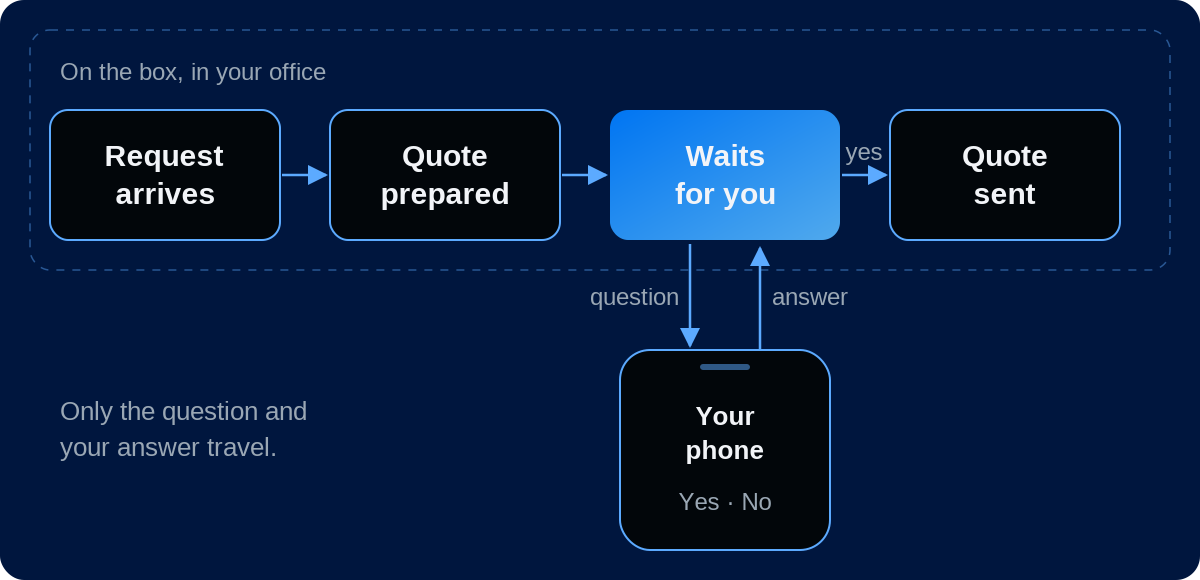
Then two answers:
- Yes: the chore carries on exactly where it paused. The quote goes out, the copy is filed.
- No: the chore does what you wrote for a no. Revise the draft, write back to the customer, hand it over to a colleague. A no is an instruction too, and you already gave it.
The approval goes to whoever the chore names. If the discounts are Marco’s call, they wait for Marco, not for you. You stay out of the loop on the decisions you have delegated, and in it on the ones you kept.
Does my data travel with the notification?
The work does not. Your phone is a remote control, not a copy of your files. The documents, the price list, the customer history and the processing stay on the box in your office. What reaches your phone is the question and the context to decide; what comes back is your yes or no.
That matters more than it sounds. The convenience of answering from anywhere usually comes with a quiet trade: the work moves to someone else’s servers so that it can reach you. Here it does not have to. The box stays put; only the decision is remote.
Every request and every answer is written in the audit trail on the box, with the time. “Who approved this quote?” has an answer six months later, without anyone digging through a chat history.
What happens while it waits?
The step is parked. It does not run “eventually”, and it does not time out into a yes. No answer, no action.
Waiting does not block the office either. Other requests keep being handled, other chores keep running, and the routine quotes that do not need you keep going out. Only the step you held is held.
If you are in a meeting for two hours, the quote is there when you come out, ready, with the reason it waited. You approve it between two coffees.
Where to start
- Pick one chore where a mistake would be embarrassing. Outgoing quotes, new suppliers, invoices that do not match the order. Not the whole office: one.
- Hold every step for the first weeks. Write “wait for my approval before sending anything” and read what it prepares. You will learn more about your Aivell in ten approvals than in any demo.
- Move the line when the record says you can. Hold only the discounts over 10%, only the new customers, only the mismatches. Strict first, looser later, never looser than you are comfortable with.
The judgment stays with you; the preparation does not have to. For how the pause works across chores and tools, see human in the loop.
Meet your Aivell before everyone else.